International Journal of Advanced Research & Studies (IJARS)
For Authors:
Fast Publication of Research and Review Papers
Science,
Engineering,
Education,
Social Sciences,
Management,
Commerce,
Medical Sciences,
Arts, Humanities,
and emerging interdisciplinary fields.The journal follows a strict peer-review process and adheres to high ethical standards as per international publication guidelines. IJARS is an India-based international journal with a global readership and editorial representation.
Aims and Scope
Before continuing with the submission of your manuscript, Kindly make sure that You have manuscript files in Microsoft Word .doc or .dox format with the tables and figures placed in the manuscript body at their appropriate places.Those who are not well versed with online submission can e-mail their article to editor@ijars.org
Send Your original Research paper as per Guidlines at editor@ijars.org
Current Issue
A Hybrid Deep Learning Model for Real-time Sentiment Analysis and Trend Prediction on Social Media Platforms
Dr. Kulwant Singh, Assistent Professor, shri Khushal Das University, Hanumangarh
A Robust Machine Learning Framework for Real-time DDoS Attack Detection in Cloud Computing Environments
Mr.Vikram Magwana, Assistant Professor, Shri Khushal Das University, Hanumangarh, Rajasthan
Benefits and Limitations of Integrating Artificial Intelligence into Real-Time Motion Planning Systems
Mr.Vikram Magwana, Assistant Professor, Shri Khushal Das University, Hanumangarh, Rajasthan
Ethical Challenges and Governance Frameworks in the Deployment of Artificial Intelligence within Healthcare Systems
Mr.Sumit garg, Assistant Professor, Shri Khushal Das University, Hanumangarh, Rajasthan
The Role of Urbanization in Modernist Poetry
• Dr Ram Kumar, Assistant Professor Shri Khushal Das University, Hanumangarh
AI-based Predictive Maintenance for Industrial IoT Systems
• Author: Ms. Komal • Affiliation:OM Sterling Global University, Hissar • Course/Department: Computer Science
Archive
March 2026

✅ All Subjects Accepted
✅ Peer-Reviewed Journal
✅ International Platform
✅ Open Access
✅ Bi-Annual Publication
📌 Last Date of Submission: 15 Jan 2026
📌 Publication Month: March 2026
International Journal of Advanced Research & Studies (IJARS) will judge any case of plagiarism on its limits. If plagiarism is detected by the editorial board member, reviewer, editor etc., in any stage of article process- before or after acceptance, during editing or at a page proof stage. We will alert the same to the author(s) and will ask them to rewrite the content or to cite the references from where the content has been taken. If more than 25% of the paper is plagiarized- the article may be rejected and the same is notified to the author. When Plagiarism Check Done? All the submitted manuscripts for publication are checked for plagiarism after submission and before starting review. Handling Plagiarism? The manuscripts or papers in which the plagiarism is detected are handled based on the extent of the plagiarism.
- <15% Plagiarism:The manuscript will be given an ID and the manuscript is sent to author for content revision.
- 16- 30% Plagiarism:The manuscript will not be given an ID and the manuscript is sent back to author for content revision.
- >30% Plagiarism: The manuscript will be rejected without the review. The authors are advised to revise the manuscript and resubmit the manuscript.
- Copying the same content from the other source. Purposely using portions of another author’s paper or content.
- Copying elements of another author’s paper, such as figures, tables, equations or illustrations that are not common knowledge, or copying or purposely using sentences without citing the source.
- Using exact text downloaded from the internet.
- Copying or downloading figures, photographs, pictures or diagrams without acknowledging your sources.
Editorial Board
Article Processing Charges
Foreign authors USD 35
Indian authorsRs. 2000/-
Peer Review Process
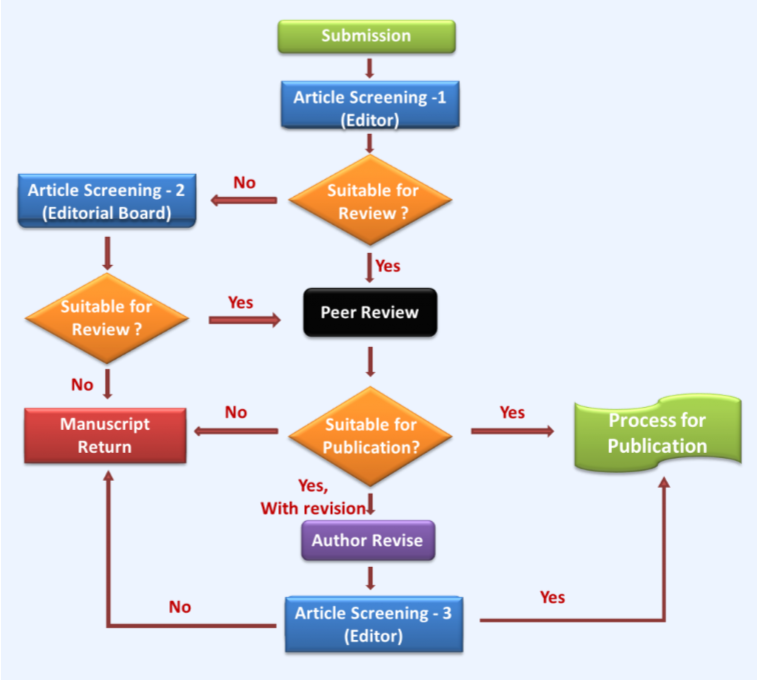
Publisher of Peer Reviewed Journals like IJARS has to follow common peer review processes.
Peer review process starts, after the author submits their work. Manuscript is checked for obvious errors by the publisher's editor who will send it to a panel of peer reviewers. Reviewers are experts in their discipline. The reviewers provide comment on the appropriateness of the work for publication and may suggest corrections to the manuscript. The work is then returned to the author by the editor. The author make the recommended alterations and resubmit it. The editor will then return it to the panel of reviewers. Finally, when the reviewers and the author agree on the final version, the work will be sent for publication by the editor.
Downloads
Publication Guidelines
Paper Format
Paper Title (24pt, Times New Roman, upper case, line spacing: Before: 8pt, after: 16pt) Subtitle if needed (14pt, Italic,line spacing: Before:8pt, after:16pt)1Name of 1st Author, 2Name of 2nd Author, 3Name of 3rd Author 1Designation of 1st Author, 2Designation of 2nd Author, 3Designation of 3rd Author 1Name of Department of 1st Author, 1Name of organization of 1st Author, City, Country
General Formatting Checklist When you start typing your full paper, keep these standard settings in mind:
- Font: Times New Roman (usually 12 pt).
- Spacing: Double-spaced (2.0) throughout the document.
- Margins: 1-inch (2.54 cm) on all sides.
- Page Numbers: Usually in the top right corner.
- Headings: Use Bold for main section headers (e.g., Methodology).
How to Cite Sources (References)
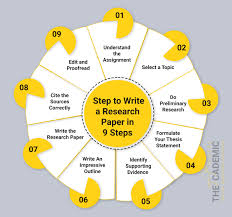
The most common style for Ph.D. research is APA Style. Here is how a book reference looks: Author’s Last Name, First Initial. (Year). Title of the book. Publisher. Example: Sharma, R. (2023). The Future of Research. Academic Press.
Research Paper Format
Paper Format
Paper Title (24pt, Times New Roman, upper case, line spacing: Before: 8pt, after: 16pt) Subtitle if needed (14pt, Italic,line spacing: Before:8pt, after:16pt)1Name of 1st Author, 2Name of 2nd Author, 3Name of 3rd Author 1Designation of 1st Author, 2Designation of 2nd Author, 3Designation of 3rd Author 1Name of Department of 1st Author, 1Name of organization of 1st Author, City, Country
General Formatting Checklist When you start typing your full paper, keep these standard settings in mind:
- Font: Times New Roman (usually 12 pt).
- Spacing: Double-spaced (2.0) throughout the document.
- Margins: 1-inch (2.54 cm) on all sides.
- Page Numbers: Usually in the top right corner.
- Headings: Use Bold for main section headers (e.g., Methodology).
How to Cite Sources (References)
The most common style for Ph.D. research is APA Style. Here is how a book reference looks: Author’s Last Name, First Initial. (Year). Title of the book. Publisher. Example: Sharma, R. (2023). The Future of Research. Academic Press.